122 AI Words to Avoid in 2026 (Copy-Paste List for ChatGPT and Claude)

These are the 122 AI words to avoid if you write with ChatGPT or Claude. They’re the verbs, adjectives, nouns and stock phrases that make a draft read like a machine wrote it. Each one comes with a plain replacement. Reading the list helps. Pasting it into your AI’s instructions helps more, so jump to the copy-paste blocks if that’s all you came for.
I’m Anton, founder of PostHero. We see a lot of content that people create with Claude and ChatGPT in PostHero, and the same words and patterns keep showing up. I put this list together to help you write better content.
The 122 AI words to avoid, by category
This list of AI words to avoid has 122 entries: 25 verbs, 25 adjectives, 20 nouns, 15 adverbs and transitions, 15 classic phrases, and 22 newer ones that arrived with the 2025-26 models. Most are fine words that AI uses too often and in the wrong places. The “write instead” column is the plain word I’d put there.
There’s research behind lists like this one. A study of more than 15 million PubMed abstracts found an abrupt rise in certain style words after ChatGPT launched. It estimated that at least 13.5% of 2024 abstracts had been processed with an LLM. I’m not going to quote per-word multipliers, because I couldn’t find a source study for the ones passed around online.
Verbs (25)
AI picks verbs that sound like progress. Nearly all of them mean “use” or “change”, and the short word reads better every time.
| AI word | Write instead | AI word | Write instead |
|---|---|---|---|
| delve | look at | embark | start |
| leverage | use | bolster | support, strengthen |
| utilize | use | spearhead | lead |
| harness | use | revolutionize | change |
| unlock | get, open up | transform | change |
| unleash | release, start | optimize | improve |
| elevate | improve, raise | facilitate | help, run |
| empower | let, help | cultivate | build, grow |
| foster | encourage, build | illuminate | explain, show |
| navigate | handle, get through | resonate | connect, land |
| streamline | simplify, speed up | supercharge | speed up, boost |
| underscore | show, stress | redefine | change |
| showcase | show |
Adjectives (25)
These are praise words with nothing behind them. Delete the adjective, and if the sentence loses no information, it was filler.
| AI word | Write instead | AI word | Write instead |
|---|---|---|---|
| crucial | important, key | transformative | say what changed |
| pivotal | important | holistic | whole, overall |
| robust | strong | meticulous | careful |
| seamless | smooth, easy | compelling | convincing, strong |
| comprehensive | full, complete | invaluable | very useful |
| intricate | complex, detailed | paramount | most important |
| multifaceted | complex (or name the sides) | profound | deep, big |
| nuanced | subtle (or say the difference) | ever-evolving | changing |
| vibrant | lively, busy | bustling | busy |
| dynamic | changing, active | unparalleled | the best, unmatched |
| innovative | new | noteworthy | worth a look |
| cutting-edge | latest, newest | commendable | good, impressive |
| groundbreaking | new, first |
Nouns (20)
Metaphor nouns fit any topic, so a model can use them without knowing anything about yours. Swap in the literal thing you mean. Where the literal thing is a real market or a real plan, say which one.
| AI word | Write instead | AI word | Write instead |
|---|---|---|---|
| tapestry | mix | game-changer | big change (say what changes) |
| landscape | market, field | treasure trove | lots of, a collection |
| realm | area, field | interplay | how X affects Y |
| journey | process, path (or cut) | nuance | detail, difference |
| testament | proof, sign | intricacies | details |
| beacon | example, guide | insights | findings, lessons |
| cornerstone | base, foundation | framework | method, system |
| synergy | fit, working together | roadmap | plan |
| paradigm | model, approach | catalyst | cause, trigger |
| ecosystem | market, network, set of tools | symphony | mix, combination |
Adverbs and transitions (15)
Models glue sentences together with formal connectors and add adverbs to tell you a point matters. In most cases you can delete the word and lose nothing, which is why half of this column says “cut”.
| AI word | Write instead | AI word | Write instead |
|---|---|---|---|
| moreover | also (or cut) | consequently | so |
| furthermore | also (or cut) | indeed | cut |
| additionally | also, and | crucially | cut |
| notably | cut | seamlessly | smoothly, easily |
| importantly | cut, then say why it matters | meticulously | carefully |
| ultimately | in the end | effortlessly | easily |
| essentially | basically (or cut) | undoubtedly | clearly (or cut) |
| arguably | I think (or cut) |
Classic phrases (15)
These are openers and wrappers: the throat-clearing around a point. The usual fix is to cut the phrase and start with whatever came after it.
| # | AI phrase | Do instead |
|---|---|---|
| 1 | “In today’s fast-paced world” | Cut it. Start with the point. |
| 2 | “It’s worth noting that” | Cut it and say the thing. |
| 3 | “It’s important to note” | Cut it and say the thing. |
| 4 | “In the realm of” | in |
| 5 | “When it comes to” | for, with, about |
| 6 | “Let’s dive in” | Cut it. |
| 7 | “At its core” | Cut it. |
| 8 | “A testament to” | shows, proves |
| 9 | “Plays a crucial role” | matters, helps (say how) |
| 10 | “In conclusion” | Cut it. End on your last real point. |
| 11 | “It’s not just X, it’s Y” | Say Y. |
| 12 | “Here’s the thing” | Cut it. |
| 13 | “The best part?” | Say the part, without the question. |
| 14 | “Navigating the complexities of” | dealing with |
| 15 | “Unlock the full potential” | get more from (or name the result) |
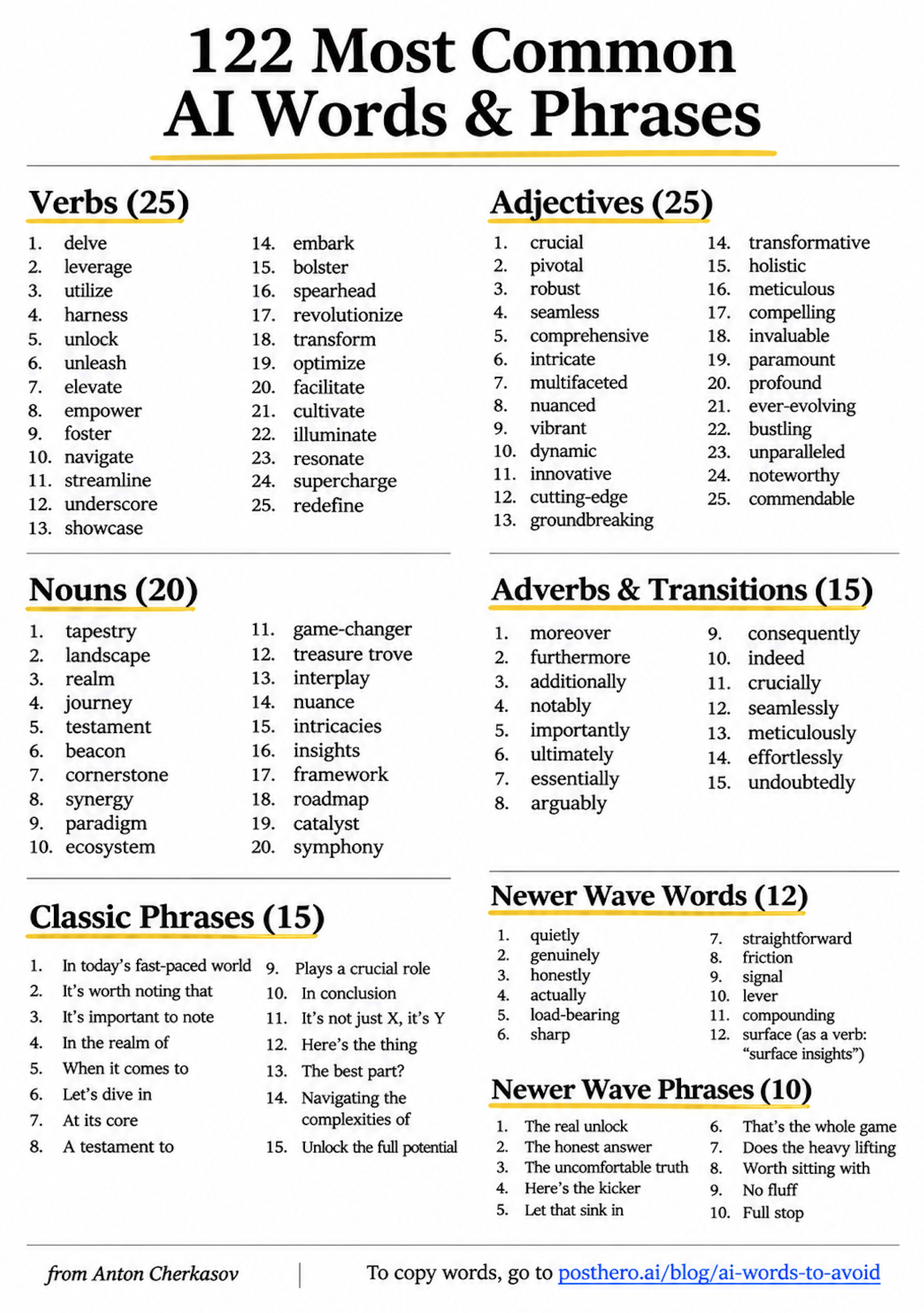
Words AI overuses in 2025-26: the newer wave
New for 2025-26
Most lists of overused AI words were written in 2024 and still lead with “delve”. That word is fading. A 2025 analysis of arXiv abstracts reported a marked drop in “delve” and similar words soon after people started pointing them out in early 2024.
The newer models write in a more casual voice, closer to a founder on LinkedIn than to a press release. Less “tapestry”, more “the real unlock”. The 22 entries below are the AI words to avoid in GPT-5 and Claude drafts now. I couldn’t find a study that counts them yet. Treat this section as field notes from editing.
The most common one right now is “quietly”: it’s the word I see most in newer client drafts.
Newer wave words (12)
| # | AI word | Do instead |
|---|---|---|
| 1 | quietly | cut |
| 2 | genuinely | cut |
| 3 | honestly | cut |
| 4 | actually | cut, unless you’re correcting something |
| 5 | load-bearing | essential, the part everything depends on |
| 6 | sharp | clear, specific |
| 7 | straightforward | simple, easy |
| 8 | friction | name the problem: delay, hassle, extra step |
| 9 | signal | sign, evidence |
| 10 | lever | option, way to |
| 11 | compounding | growing, adding up |
| 12 | surface (as a verb: “surface insights”) | show, find, bring up |
Newer wave phrases (10)
| # | AI phrase | Do instead |
|---|---|---|
| 1 | “The real unlock” | Say what helped. |
| 2 | “The honest answer” | Give the answer. |
| 3 | “The uncomfortable truth” | State it. |
| 4 | “Here’s the kicker” | Cut it. |
| 5 | “Let that sink in” | Cut it. |
| 6 | “That’s the whole game” | Cut it, or say why it matters most. |
| 7 | “Does the heavy lifting” | does most of the work |
| 8 | “Worth sitting with” | worth thinking about |
| 9 | “No fluff” | Cut it. Being short proves it. |
| 10 | “Full stop” | Cut it. The period is enough. |
Common AI words that are fine in normal writing
Some entries on this list are ordinary English. “Actually”, “honestly”, “insights”, “framework”, “signal” and “straightforward” were in use long before any chatbot, and a software framework should still be called a framework.
One of these words in a 600-word post means nothing. The tell is a cluster: four or five of them within a few paragraphs, usually next to the patterns in the next section. A human who writes “crucial” once isn’t writing like AI. Winston AI, which sells a detector, says much the same about its own product. There’s no banned-word list inside it, and what gets flagged is repetition and predictability across a whole text.
That’s also why I wouldn’t use a list of AI words to avoid to accuse anyone. It’s an editing checklist for drafts you already know came from a model.
Why banning overused AI words isn’t enough
Give a model a ban list and it reaches for the nearest synonym. Ban “delve” and you get “dig into”. Ban “crucial” and “vital” turns up in the same slot, doing the same job.
The bigger problem is shape. AI writing is recognizable even with every word on the list removed, because the sentences and paragraphs follow a small set of habits. These are the six patterns I’d ban along with the AI words to avoid:
| Pattern | What it looks like | Do instead |
|---|---|---|
| Em dashes | Two or three long dashes in one paragraph | A comma, a colon, or two sentences |
| “It’s not X, it’s Y” | “It’s not a tool, it’s a mindset.” | Say what it is |
| Groups of three | “faster, smarter, and more efficient” | Two items, or four, or the one that matters |
| A question answered by the writer | “The best part? It’s free.” | “It’s free.” |
| One-line dramatic paragraphs | A short line standing alone for effect, several times in one post | Join it to the paragraph it belongs to |
| A summary line ending every section | “In short, consistency wins.” | End on the last real point |
Copy-paste list of AI words to avoid for ChatGPT and Claude
Each block has the same parts: banned words, banned patterns, and what to do instead. The last part matters most, because a model that’s only told what to avoid goes looking for synonyms. Click a block once to select all of it, then copy.
ChatGPT words to avoid: custom instructions block
OpenAI’s help page lists a 1,500-character limit for custom instructions on Free and Go plans. Paid plans get 5,000 (checked 16 November 2026). All 122 entries don’t fit in 1,500, so this block keeps the worst offenders and all six patterns. It’s 1,257 characters. In ChatGPT, open Settings, then Personalization, and paste it into the Custom Instructions field.
Writing rules. Follow them in every reply.
Never use these words: delve, leverage, utilize, harness, unlock, unleash, elevate, empower, foster, streamline, underscore, showcase, embark, revolutionize, crucial, pivotal, robust, seamless, comprehensive, multifaceted, vibrant, cutting-edge, transformative, holistic, tapestry, landscape, realm, testament, synergy, game-changer, moreover, furthermore, additionally, notably, ultimately, quietly, genuinely, load-bearing.
Never use these phrases: “In today’s fast-paced world”, “It’s worth noting”, “It’s important to note”, “When it comes to”, “Let’s dive in”, “At its core”, “In conclusion”, “Here’s the thing”, “The best part?”, “The real unlock”, “The honest answer”, “Here’s the kicker”, “Let that sink in”, “Full stop”.
Never use these patterns: em dashes; “It’s not X, it’s Y”; lists of exactly three; a question you answer yourself; one-line paragraphs for drama; a summary line at the end of a section.
Do this instead: use the plain word (use, help, show, important, strong). Don’t swap a banned word for a fancier synonym; rewrite the sentence. Keep most sentences under 20 words. Give one specific example, number or name in place of a general claim. If you can’t say something plainly, cut it.
On a paid plan, use the full block below. It’s 2,722 characters, well inside 5,000.
Full block for a Claude Project (all 122)
Paste this into a Claude Project’s instructions and it applies to every chat in that project. To apply it to all your conversations, put it in the instructions for Claude in your settings. Anthropic’s personalization guide explains the difference. You can also save it as a custom style. The styles page says custom styles are being turned into skills, though, so I’d go with project instructions.
Writing rules. Follow them in everything you write for me.
BANNED WORDS (any form of the word)
Verbs: delve, leverage, utilize, harness, unlock, unleash, elevate, empower, foster, navigate, streamline, underscore, showcase, embark, bolster, spearhead, revolutionize, transform, optimize, facilitate, cultivate, illuminate, resonate, supercharge, redefine
Adjectives: crucial, pivotal, robust, seamless, comprehensive, intricate, multifaceted, nuanced, vibrant, dynamic, innovative, cutting-edge, groundbreaking, transformative, holistic, meticulous, compelling, invaluable, paramount, profound, ever-evolving, bustling, unparalleled, noteworthy, commendable
Nouns: tapestry, landscape, realm, journey, testament, beacon, cornerstone, synergy, paradigm, ecosystem, game-changer, treasure trove, interplay, nuance, intricacies, insights, framework, roadmap, catalyst, symphony
Adverbs and transitions: moreover, furthermore, additionally, notably, importantly, ultimately, essentially, arguably, consequently, indeed, crucially, seamlessly, meticulously, effortlessly, undoubtedly
Newer AI words: quietly, genuinely, honestly, actually, load-bearing, sharp, straightforward, friction, signal, lever, compounding, surface (as a verb, “surface insights”)
BANNED PHRASES
“In today’s fast-paced world”, “It’s worth noting that”, “It’s important to note”, “In the realm of”, “When it comes to”, “Let’s dive in”, “At its core”, “A testament to”, “Plays a crucial role”, “In conclusion”, “It’s not just X, it’s Y”, “Here’s the thing”, “The best part?”, “Navigating the complexities of”, “Unlock the full potential”, “The real unlock”, “The honest answer”, “The uncomfortable truth”, “Here’s the kicker”, “Let that sink in”, “That’s the whole game”, “Does the heavy lifting”, “Worth sitting with”, “No fluff”, “Full stop”
BANNED PATTERNS
– Em dashes. Use a comma, a colon or two sentences.
– “It’s not X, it’s Y” contrasts. Say what the thing is.
– Lists of exactly three. Use two items, or four, or the one that matters.
– A question you answer yourself (“The best part?”).
– One-line paragraphs for dramatic effect.
– A summary line at the end of a section or post.
DO THIS INSTEAD
– Use the plain word: use, help, show, start, change, important, strong, also, so.
– Never replace a banned word with a fancier synonym (delve -> dig into). Rewrite the sentence or cut it.
– If a banned word is the literal, correct term (a software framework, a radio signal, navigating a ship), keep it.
– Keep most sentences under 20 words and vary their length.
– Replace general claims with one specific example, number or name. If you don’t have one, ask me.
– Before you answer, reread your draft and fix anything that breaks these rules.
Short version for a single prompt
For a one-off request where you don’t want to touch your settings. Add it to the end of your prompt.
Write this in plain English. Don’t use: delve, leverage, utilize, unlock, elevate, foster, streamline, crucial, robust, seamless, comprehensive, landscape, realm, journey, testament, moreover, furthermore, ultimately, genuinely, quietly. No em dashes, no “It’s not X, it’s Y”, no lists of three, no questions you answer yourself, no summary line at the end. Use short sentences, plain words and one specific example. Don’t swap a banned word for a synonym: rewrite the sentence.
“Check my draft” prompt
Use this on a draft that already exists, yours or the AI’s. It flags what it finds and rewrites only those sentences, so the rest of your text stays as you wrote it.
Check the draft below against these rules.
1. List every banned word, phrase and pattern you find, each with the sentence it appears in.
2. Rewrite only those sentences, in plain words. Don’t swap a banned word for a synonym: rewrite the sentence or cut it.
3. Leave every other sentence exactly as it is.
4. Return the full corrected draft, then a short list of what you changed.
If a banned word is the literal, correct term (a software framework), keep it and say so.
Banned words (any form): delve, leverage, utilize, harness, unlock, unleash, elevate, empower, foster, navigate, streamline, underscore, showcase, embark, bolster, spearhead, revolutionize, transform, optimize, facilitate, cultivate, illuminate, resonate, supercharge, redefine, crucial, pivotal, robust, seamless, comprehensive, intricate, multifaceted, nuanced, vibrant, dynamic, innovative, cutting-edge, groundbreaking, transformative, holistic, meticulous, compelling, invaluable, paramount, profound, ever-evolving, bustling, unparalleled, noteworthy, commendable, tapestry, landscape, realm, journey, testament, beacon, cornerstone, synergy, paradigm, ecosystem, game-changer, treasure trove, interplay, nuance, intricacies, insights, framework, roadmap, catalyst, symphony, moreover, furthermore, additionally, notably, importantly, ultimately, essentially, arguably, consequently, indeed, crucially, seamlessly, meticulously, effortlessly, undoubtedly, quietly, genuinely, honestly, actually, load-bearing, sharp, straightforward, friction, signal, lever, compounding, surface (as a verb, “surface insights”)
Banned phrases: “In today’s fast-paced world”, “It’s worth noting that”, “It’s important to note”, “In the realm of”, “When it comes to”, “Let’s dive in”, “At its core”, “A testament to”, “Plays a crucial role”, “In conclusion”, “It’s not just X, it’s Y”, “Here’s the thing”, “The best part?”, “Navigating the complexities of”, “Unlock the full potential”, “The real unlock”, “The honest answer”, “The uncomfortable truth”, “Here’s the kicker”, “Let that sink in”, “That’s the whole game”, “Does the heavy lifting”, “Worth sitting with”, “No fluff”, “Full stop”
Banned patterns: em dashes; “It’s not X, it’s Y” contrasts; lists of exactly three; a question the writer answers themselves; one-line paragraphs for drama; a summary line at the end of a section.
Draft:
[paste your draft here]
Test: one paragraph, before and after
This is an example, not a benchmark. Claude wrote both versions for this article: the first in default AI style, the second with the short block applied. The topic was “why posting consistently on LinkedIn matters”.
Before
In today’s fast-paced world, consistency is crucial for building a robust LinkedIn presence. It’s not just about posting more, it’s about showing up with intention. By leveraging a content calendar, you can seamlessly streamline your workflow, foster real connections, and unlock new opportunities. The best part? You don’t need to be an expert to embark on this journey.
Four sentences, 12 entries from the list, and a group of three in the third one.
After
Post on LinkedIn on the same two days every week. People start to expect you, and a regular writer is easier to remember than a brilliant one who shows up once a quarter. Plan the week’s posts in one sitting, so you never face a blank page on posting day. You don’t need to be an expert to start.
The rules can’t add knowledge the model doesn’t have. What they do is remove the padding. Once it’s gone, the paragraph has to say something specific or there’s nothing left on the page.
FAQ
What are the most overused AI words?
The ones that turn up on most lists I read are “delve”, “tapestry”, “leverage” and “embark”. They’re the first AI words to avoid and the easiest to fix, because each has a one-word plain replacement in the tables above.
What words sound like AI in 2026?
The casual ones. Drafts from current models lean on “quietly”, “genuinely”, “load-bearing” and phrases like “the real unlock” far more than on “delve”. The full set is in the copy-paste blocks and the newer wave section.
Do AI detectors look for these words?
Partly. GPTZero publishes an AI vocabulary list built from 3.3 million texts. It says its top 50 entries show up 10 to 200+ times more often in AI text than in human text. That’s the vendor’s own figure. Detectors also score things a word list can’t see, like how predictable and repetitive the whole text is.
Will avoiding these words make my text undetectable?
No. A 2025 study built classifiers on GPTZero’s vocabulary list. They fell to near-random on essays written by Claude, so word lists are a weak test in both directions. A list of AI words to avoid won’t hide AI text from a detector. This list exists to make drafts read better, and a detector score is a separate problem.
Is it bad to use “delve” if I’m human?
No. It’s a normal word, and people wrote it long before ChatGPT. The risk is social: some readers now see it and assume a machine wrote the sentence. If that bothers you, “look at” does the same job.
Does this work in Claude and ChatGPT?
Yes. Each block is a plain instruction listing the AI words to avoid, so it works in both. It should work in any chat model that accepts instructions. Models tend to follow rules less reliably as a conversation gets long, so paste the short version again if the old habits come back.
If you write social posts with AI
PostHero connects to Claude and ChatGPT. The AI does the writing, with your AI words to avoid pasted in, and PostHero schedules the posts on eight platforms from the same chat. Here’s how to connect Claude to all your social media, and why I made PostHero work with any AI agent.
PostHero for Claude and ChatGPT
Run all your socials from one chat
Connect Claude or ChatGPT to 8 platforms in 2 minutes. Write the idea once, then let AI adapt it for each one.
7-day free trial. Everything starts as a draft.